Executive Summary:
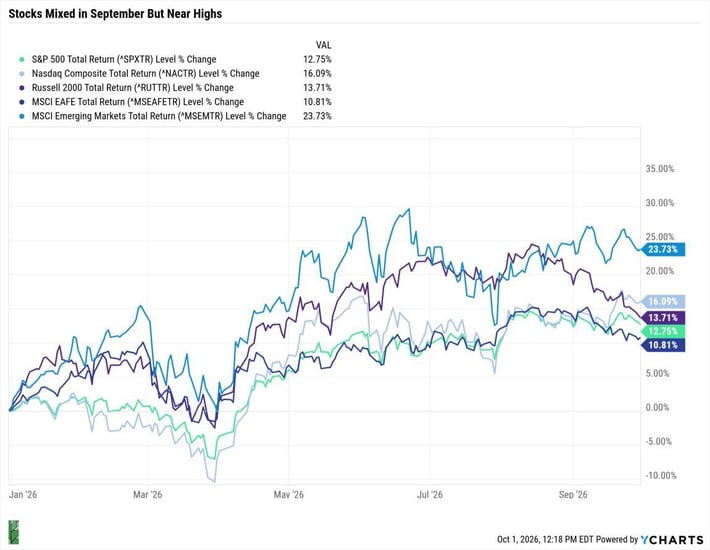
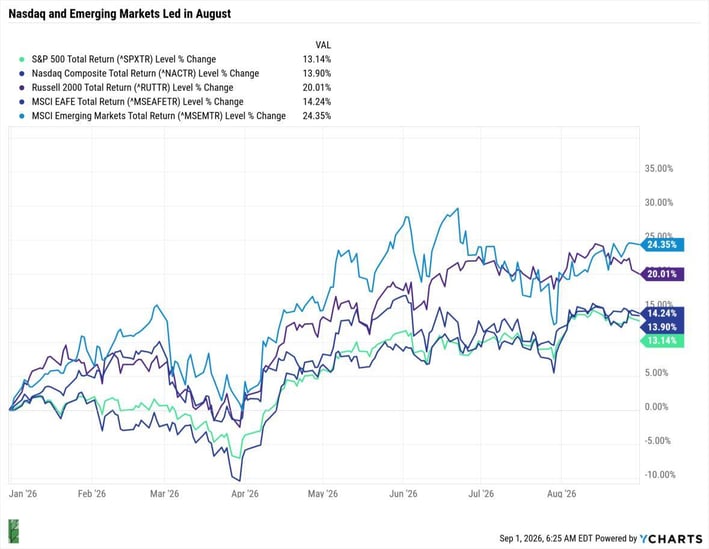
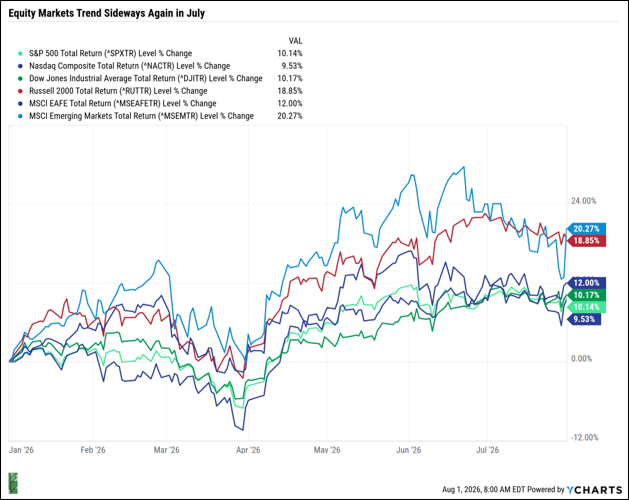
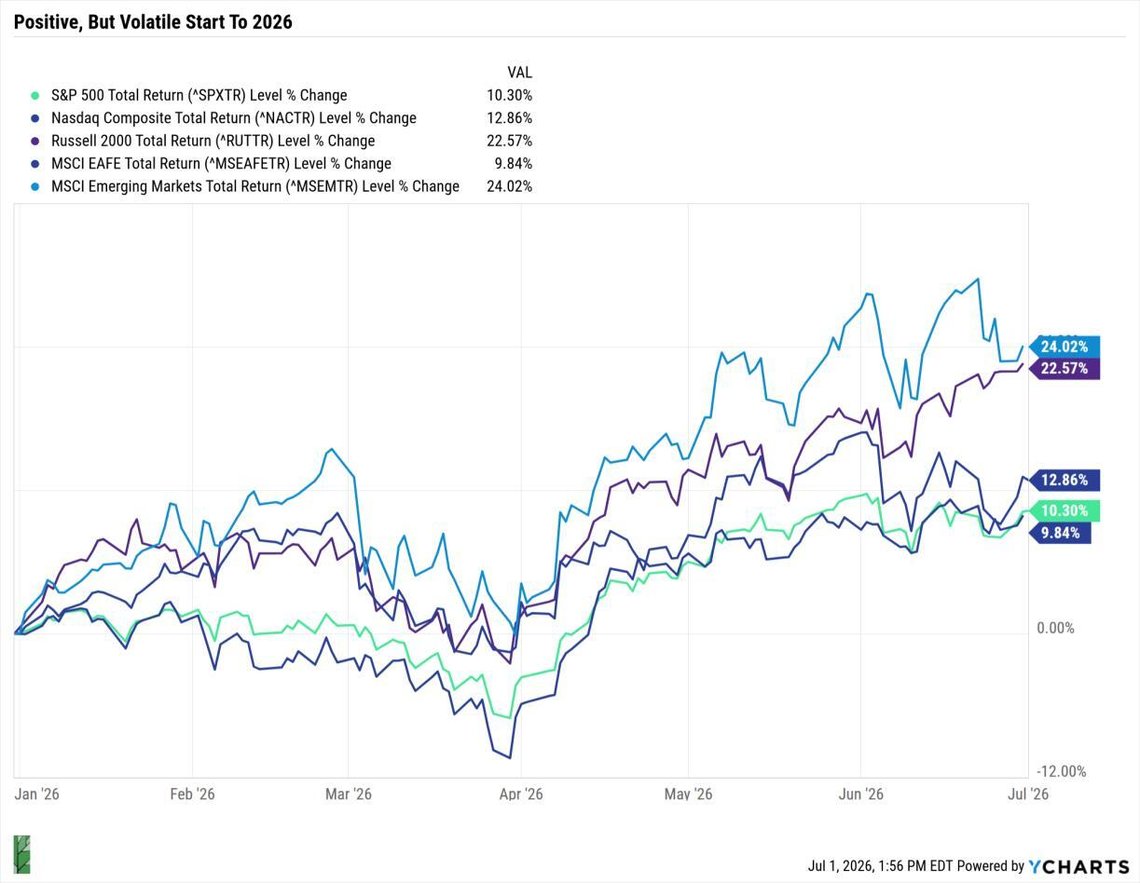
- Equity markets continued to climb throughout May, with many indexes closing near all-time highs despite the absence of a resolution in the US-Iran conflict.
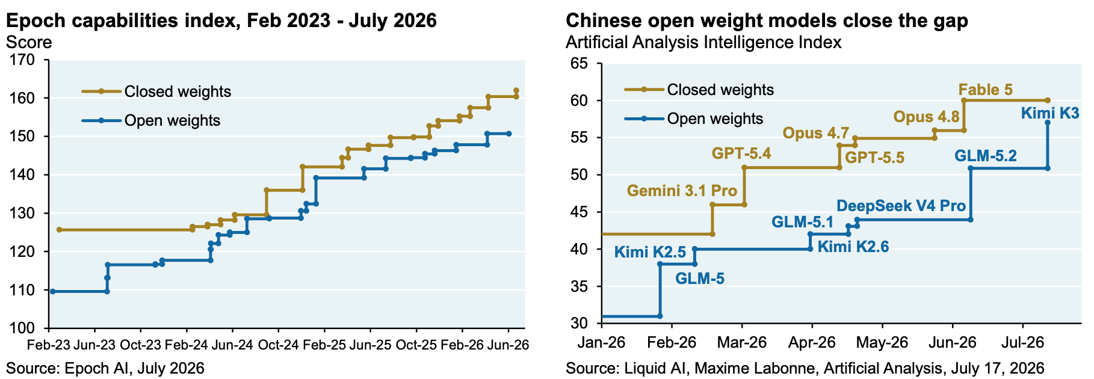
- Strong corporate earnings, positive artificial intelligence (AI) momentum, renewed interest in quantum computing, and excitement over the potential upcoming initial public offerings (IPOs) are helping to drive optimism.
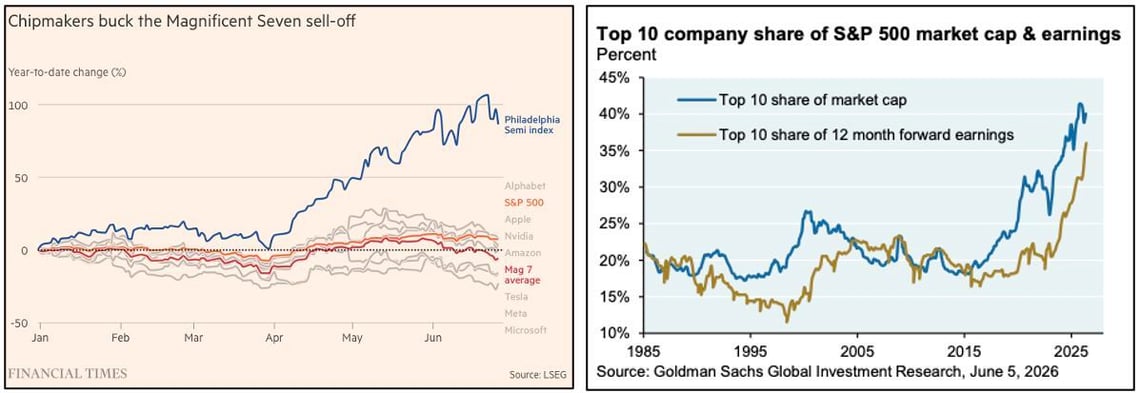
- Technology stocks continue to lead markets higher; however, leadership has broadened out beyond the Magnificent 7 to other companies.
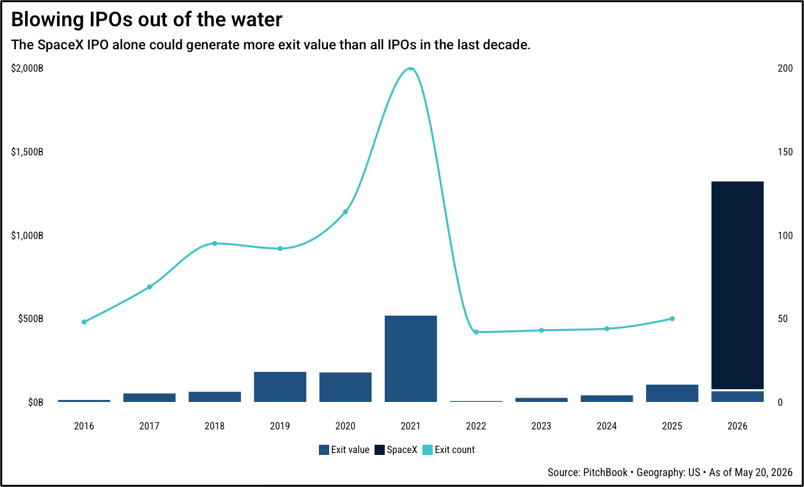
- The upcoming IPO of SpaceX, which appears to be on track to be the largest IPO in history, has generated significant interest among retail and institutional investors alike and appears to be causing index providers to revisit their methodology in an effort to participate
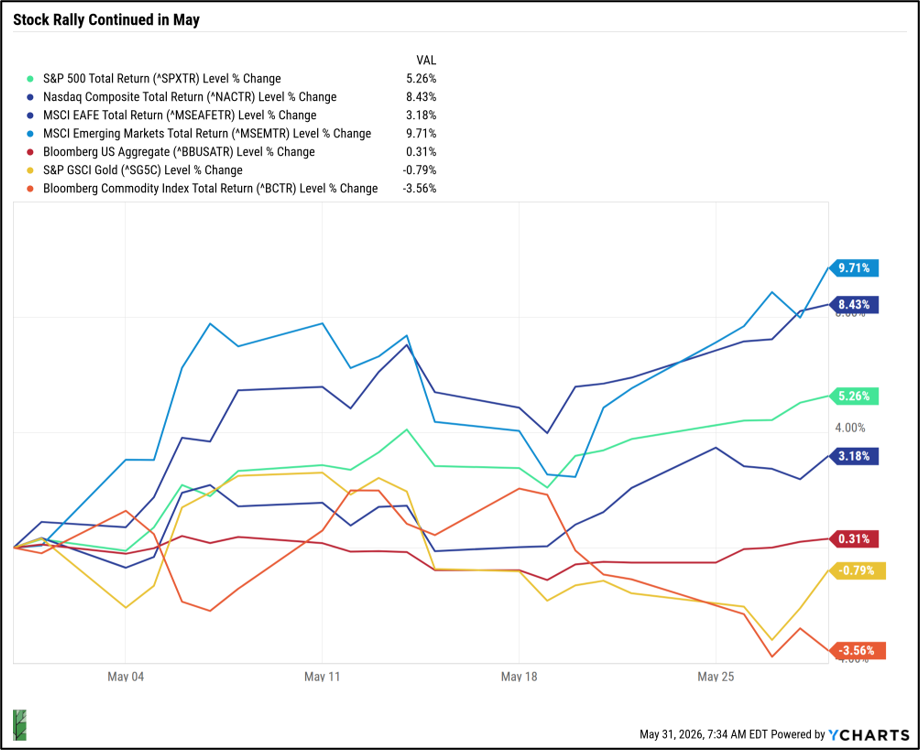
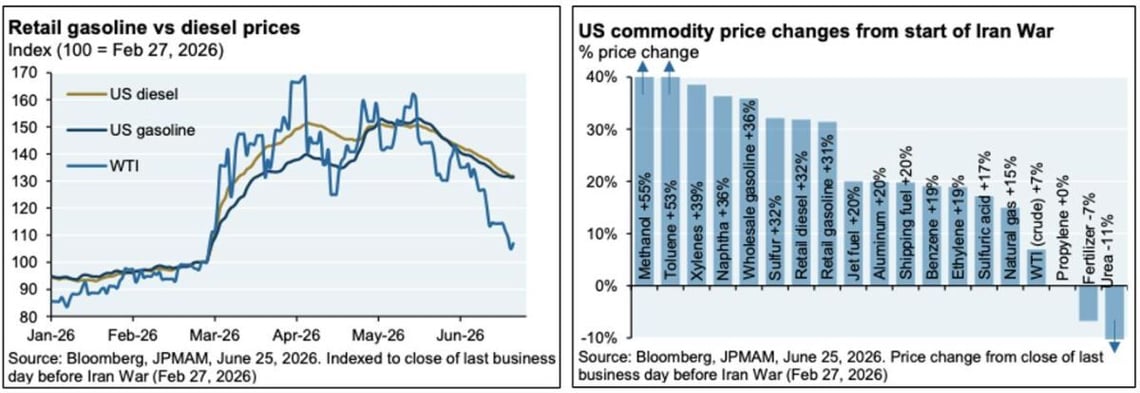
The rise in equity markets occurred despite what remains a somewhat challenging geopolitical environment. Investors appear to be looking past the conflict in Iran, hoping an agreement to end the conflict and open the Strait of Hormuz is reached soon. As the month drew to a close, President Trump stated he intends to meet with his advisors to consider the peace deal.
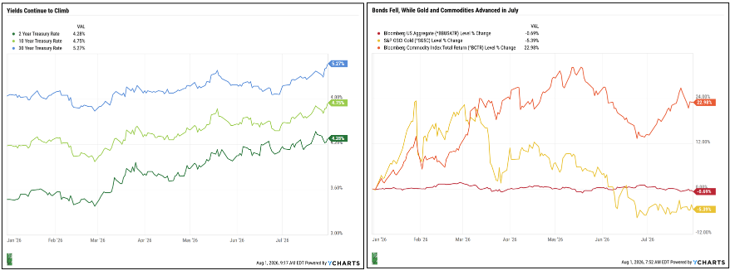
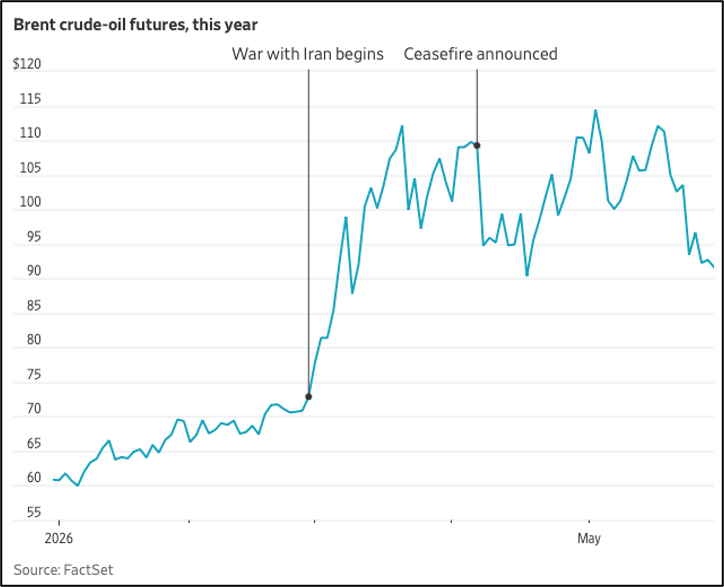
Optimism that a deal will be reached soon was also evident in energy markets. After topping out near $115 per barrel earlier in the year, Brent crude oil futures fell 19% during May, ending the month at about $92 per barrel. Similarly, West Texas crude fell 17% for the month.[i]
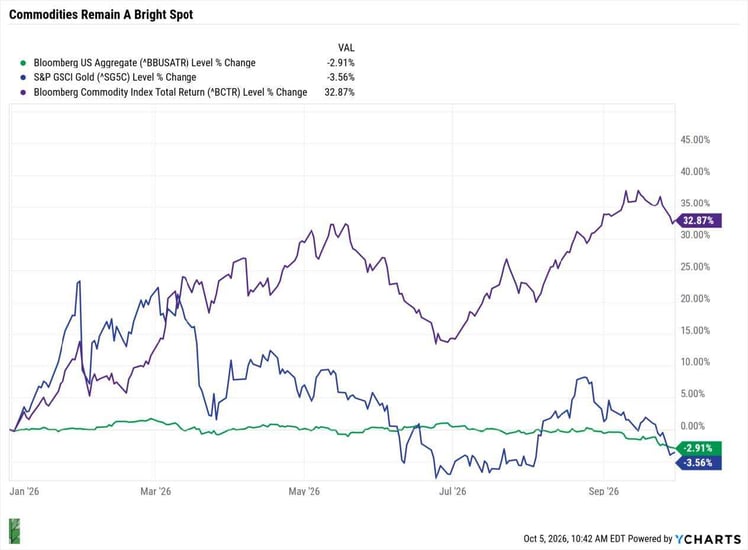
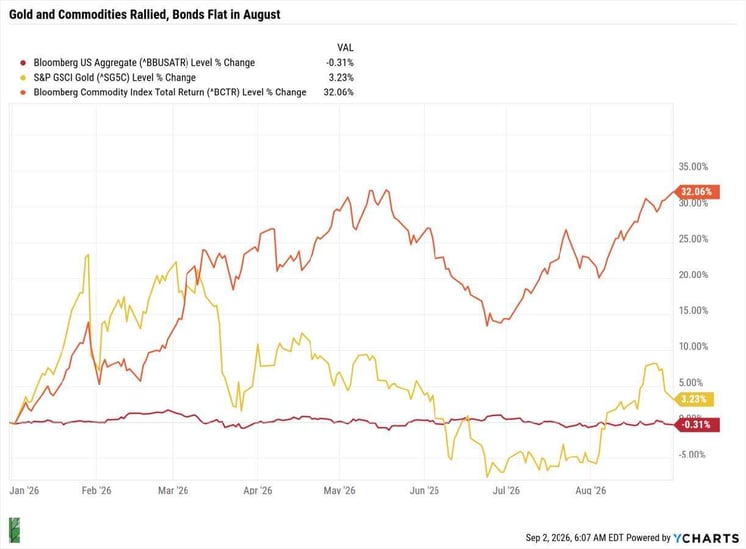
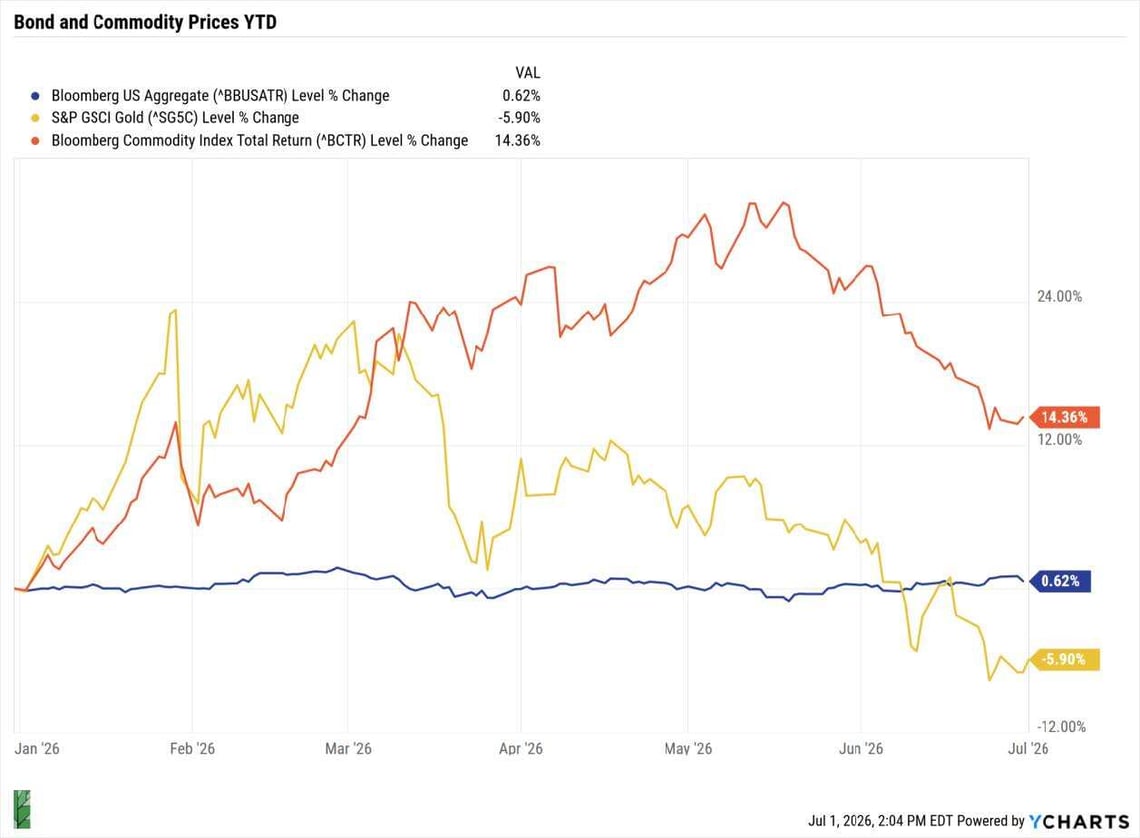
Aside from stocks, other asset classes produced mixed results in May. The Bloomberg Commodity Index gave back some of its year-to-date gains, falling approximately 3.6%, as energy prices receded and gold fell slightly for the month (see S&P GSCI Gold index above).
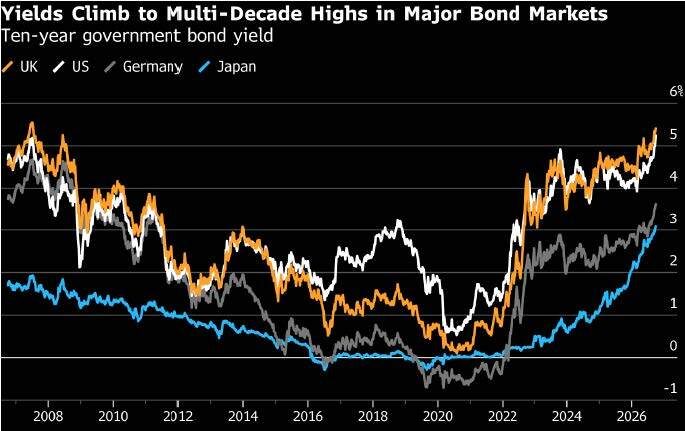
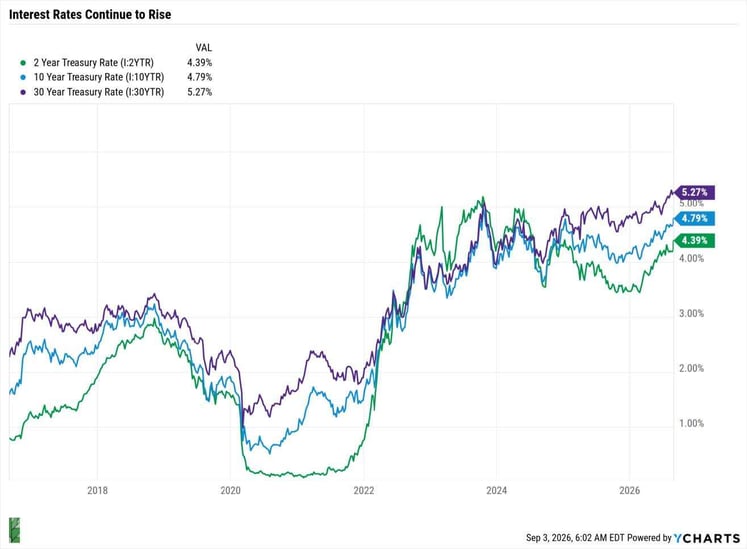
The 10-year Treasury yield closed May at approximately 4.45%, finishing near its post-cease-fire high, while the 2-year Treasury yield ended the month slightly higher, as well, at 3.98%. Bond markets continue to contend with higher inflation (more on that below), a new Federal Reserve Chair, and the growth of our national debt (US public debt recently exceeded GDP for the first time since 1946).[i] Bonds were essentially flat for the month as investors considered all of these factors, as the Bloomberg US Aggregate Bond index was up 0.3% (as indicated in the first chart above).[ii]
Economic Data Remains Mixed
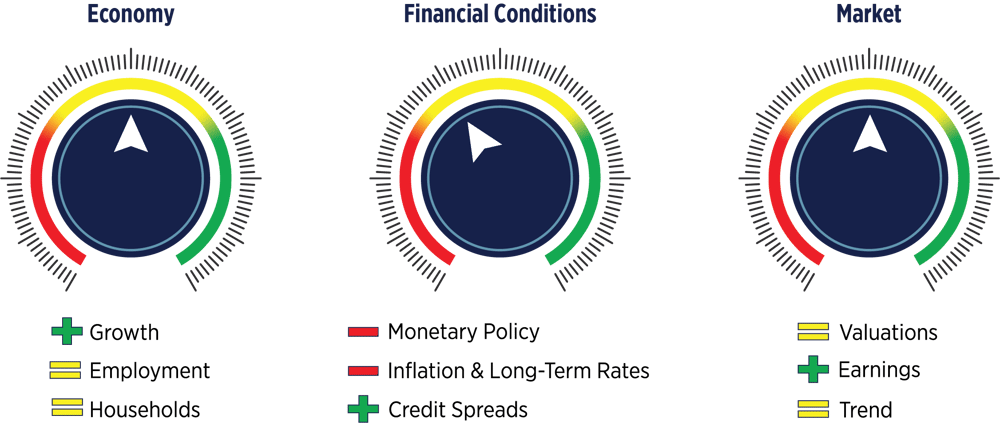
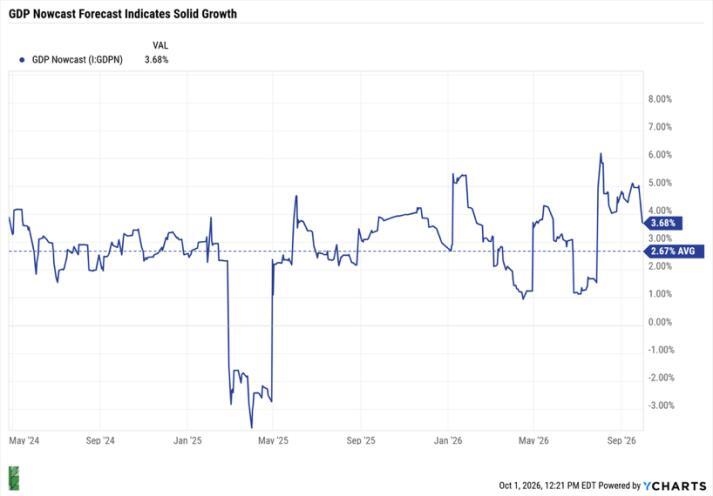
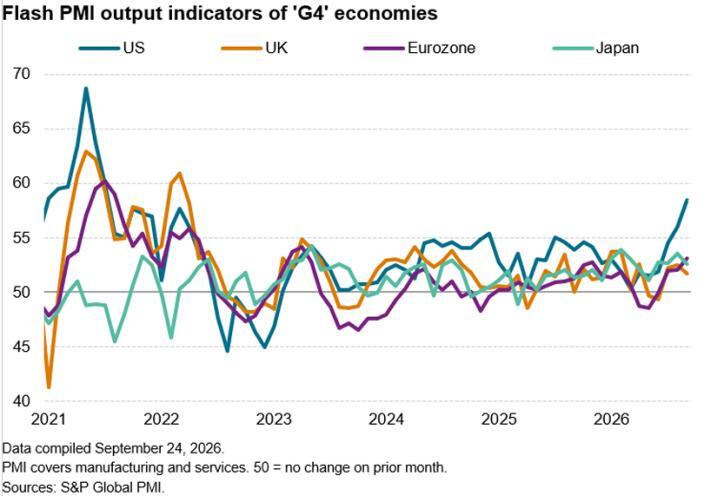
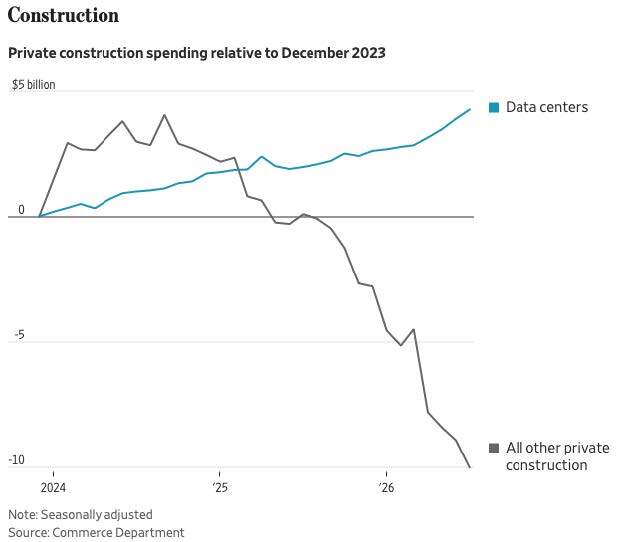
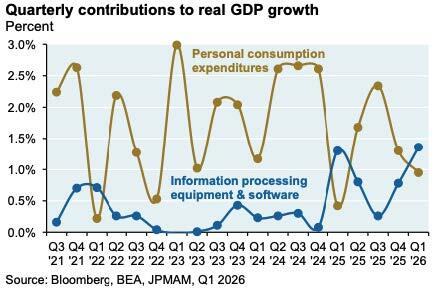
Compared to the market, which has been quite bullish over the past two months, US economic data remains much more nuanced. Economic growth remains positive, with quarter-over-quarter gross domestic product (GDP) increasing modestly at 1.6%. GDPNow, a model published by the Federal Reserve Bank of Atlanta, provided a more bullish real-time estimate of quarterly GDP of 3.0% as May ended (driven in part by AI infrastructure spending, discussed last month).[iii][iv] When viewed alongside official unemployment figures (a relatively low 4.3% as of May 31), the economic situation appears quite solid.
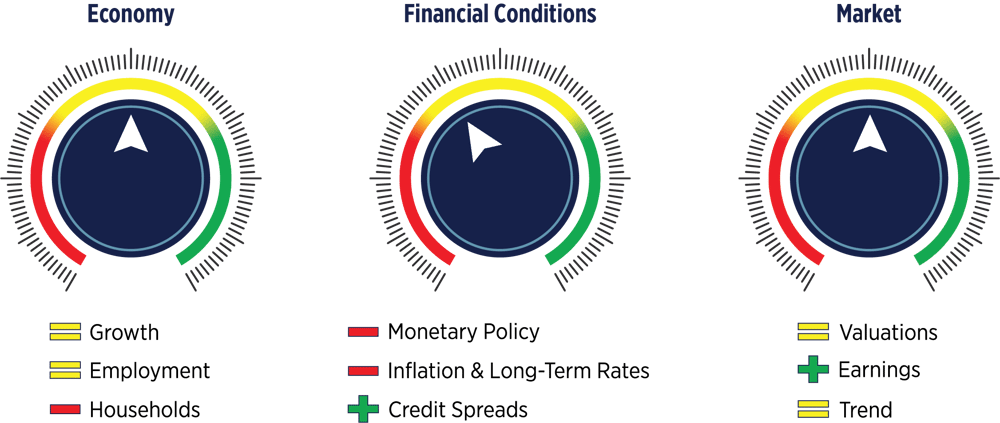
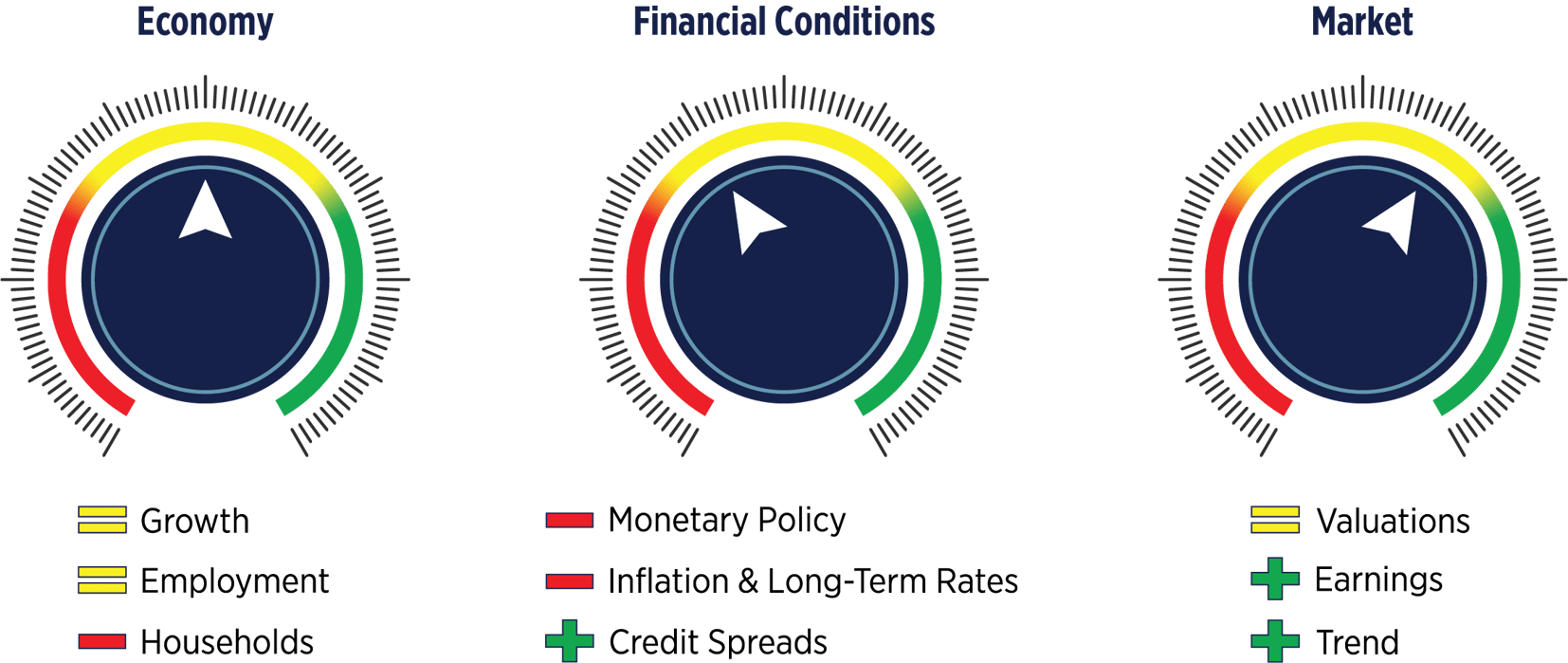
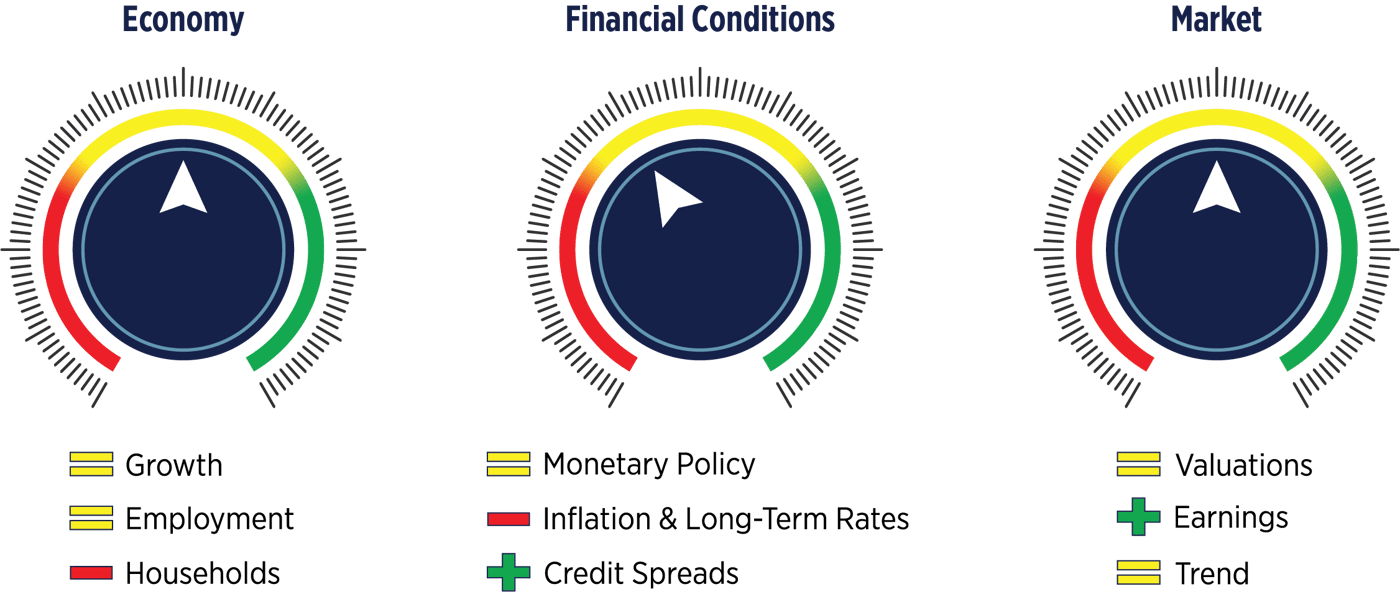
However, elevated inflation, along with growing national and household debt levels, muddy the picture somewhat. The Consumer Price Index (CPI) currently sits at 3.8% year-over-year, well above the Federal Reserve (Fed) target of 2%.[v] In addition, price increases related to the Iran conflict may not be completely captured by inflation data yet, meaning it is possible that inflation keeps climbing for several months even if a peace agreement is reached soon, making it difficult for the Fed to justify near-term interest rate cuts (“Monetary Policy” moved to negative).
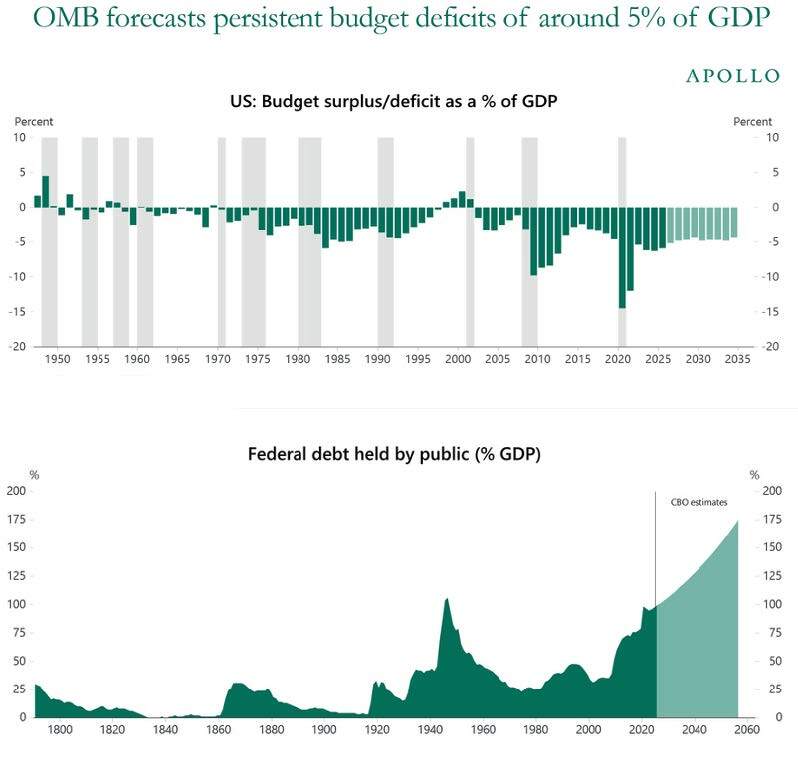
As mentioned above, our national debt also continues to climb, recently eclipsing 100% of GDP (see below left).[vi] We believe this is, at least in part, driving long-term Treasury bond yields higher.[vii] We are also seeing stress at the household level, as delinquencies in credit card debt, student loans, auto loans, and mortgages are all trending higher (see below right).[i]
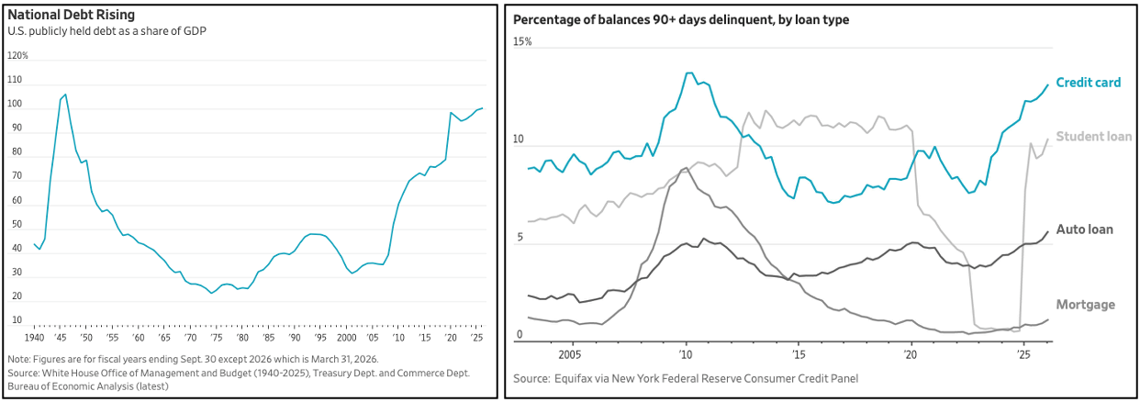
It is worth noting that rising debt levels alone rarely cause economic downturns. However, when considered alongside rising inflation and all-time low consumer sentiment figures, they do serve to counterbalance the optimism we have witnessed in equity markets recently.[i] They also create a challenging situation for the new Federal Reserve Chair, Kevin Warsh.
The Path Forward – IPO FOMO
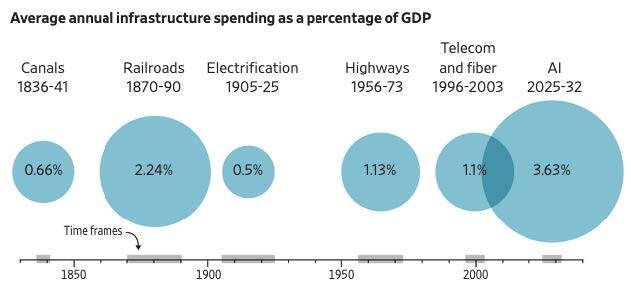
With investors looking through the conflict in Iran, bullish sentiment appears to be back in control. Much of the optimism is warranted in our opinion, as we highlighted strong corporate earnings and continued AI infrastructure spending driving economic growth earlier in this piece.
Adding to that optimism is a trio of potential initial public offerings (IPOs) that appear to be coming soon. An IPO is when a private firm decides to make its shares available to the general public on a stock exchange like the New York Stock Exchange or the Nasdaq. It can provide the owners of the company with liquidity, provide the company with new sources of capital, and give the public an opportunity to invest in companies that were previously difficult to access for most investors.
SpaceX, OpenAI, and Anthropic have generated a tremendous amount of excitement this year because of their leadership positions in their respective domains and their sheer size. For example, SpaceX is the leading rocket launch service provider, the leader in low earth orbit satellite deployment (through Starlink), and a major social media platform (through X).[ii] Meanwhile, OpenAI and Anthropic are arguably the two most advanced AI labs in the world.
As mentioned above, the size of these companies also makes this situation unique. For perspective, the SpaceX IPO is expected to be the largest in history, with its estimated exit value exceeding that of all IPOs over the past decade combined (see below)
.
OpenAI and Anthropic, while not valued as high as SpaceX, both appear to be targeting IPO valuations of nearly $1 trillion. OpenAI, the company that brought artificial intelligence mainstream in November 2022 with the launch of ChatGPT, is targeting its public offering as early as September.[i] Last but not least is Anthropic, whose AI tool, Claude, has soared in popularity and helped to increase its valuation sixfold over the past year alone.[ii] As of the time of this writing, Anthropic confjjjidentially filed a draft proposal to go public.[iii] If the three companies go public at estimated valuations, they will all become top 20 holdings in the S&P 500 based on current valuations.[iv]
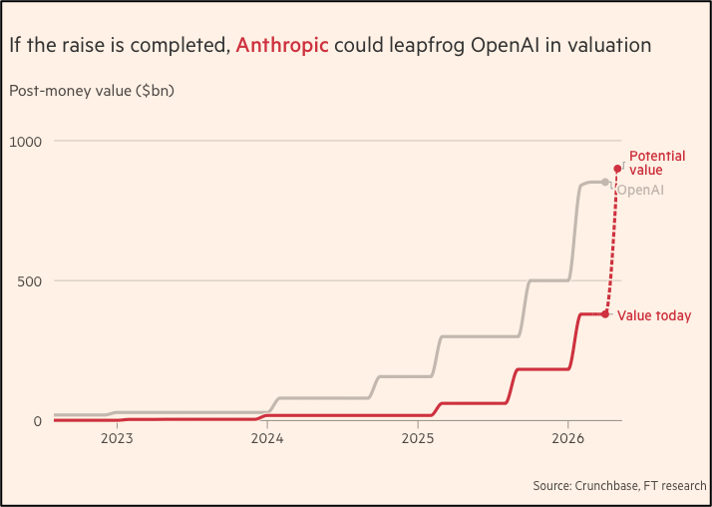
Two other factors make this environment unique – the rise of passive investing and index providers potentially changing their rules to participate in the IPOs. Passive investing has risen significantly over the past few decades, with studies finding that approximately half of all global equity investing is in passive strategies.[18] As a result, being added or removed from an index can bring with it significant capital flows into or out of your company stock, meaning index providers exercise a tremendous amount of power through the rules they establish.
Currently, index providers such as Nasdaq, S&P Dow, CRSP, and FTSE Russell are revisiting their criteria for index inclusion. As of publication date, Nasdaq, FTSE Russell, and CRSP have modified their methodologies to allow for faster entry into indexes, with potential index inclusion after five trading days post-IPO for CRSP and FTSE Russell, fifteen trading days for Nasdaq. S&P Dow has not currently announced any methodology changes; however, they are reportedly considering similar modifications. Wherever index providers choose to draw their lines, differences in methodologies related to IPOs (not just inclusion timing, but also in float levels and liquidity/profitability measures) may result in differences in performance and volatility for index-based investments.[19]
We believe that the addition of SpaceX, OpenAI, and Anthropic to public markets is a positive. All three are industry leaders in incredibly important fields. Allowing investors greater access to them is a positive in our opinion.
However, we have found that in bullish market environments, the fear of missing out, or FOMO, can lead investors to make irrational decisions. Fundamental investing pillars like valuation and profitability, and risk management concerns such as solid corporate governance and key-person risk are often abandoned at the worst times. We encourage investors to exercise patience in such times, and to recognize that speculating and long-term investing are very different exercises.
As always, we appreciate your continued trust and welcome the opportunity to speak with you in greater detail regarding your specific situation.
Sources & References
[1] Source: YCharts, May 31, 2026 – for all performance returns above
[2] Source: The Wall Street Journal, “Oil Declines Lift Stocks to Fresh Records,” May 29, 2026. https://www.wsj.com/finance/stocks/oil-declines-lift-stocks-to-fresh-records-243d065e?mod=Searchresults&pos=1&page=1
[3] Source: The Wall Street Journal, “Oil Declines Lift Stocks to Fresh Records,” May 29, 2026. https://www.wsj.com/finance/stocks/oil-declines-lift-stocks-to-fresh-records-243d065e?mod=Searchresults&pos=1&page=1
[4] Source: The Wall Street Journal, “US Debt Tops 100% of GDP,” April 20, 2026. https://www.wsj.com/economy/u-s-debt-tops-100-of-gdp-81c013d7?mod=article_inline
[5] Source: YCharts, May 31, 2026 – for GDP and unemployment data
[6] Source: https://www.atlantafed.org/research-and-data/data/gdpnow#tab-2
[7] Reference: https://www.investmentresearchpartners.com/post/the-dashboard-may-2026
[8] Source: YCharts, May 31, 2026
[9] Source: The Wall Street Journal, “US Debt Tops 100% of GDP,” April 20, 2026. https://www.wsj.com/economy/u-s-debt-tops-100-of-gdp-81c013d7?mod=article_inline
[10] Source: Financial Times, “What will drag the financial system into another crisis,” April 20, 2026. https://www.ft.com/content/5a648eba-6677-47c8-89a6-71e2fb4d6fce?syn-25a6b1a6=1
[11] Source: The Wall Street Journal, “Americans Are Falling Behind on Their $1.25 Trillion Credit Card Bill, May 29, 2026. https://www.wsj.com/personal-finance/credit/us-credit-card-debt-af5c7c77?mod=Searchresults&pos=1&page=1
[12] Source: YCharts, June 2, 2026
[13] Source: Morningstar, “SpaceX: What Investors Neet To Know About Its Enormous Upcoming IPO,” June 1, 2026. https://www.morningstar.com/stocks/spacex-what-investors-need-know-about-its-enormous-upcoming-ipo
[14] Source: https://www.ft.com/content/028a169f-cd1c-438b-b50d-df4af6297318?syn-25a6b1a6=1
[15] Source: https://www.ft.com/content/a40cafcc-0fa4-4e70-9e24-90d826aea56d?syn-25a6b1a6=1
[16] Source: Bloomberg, “Anthropic Files Confidentially for IPO in Race With OpenAI,” June 1, 2026. https://www.bloomberg.com/news/articles/2026-06-01/anthropic-files-confidentially-for-ipo-as-claude-demand-surges?cmpid=eveus&utm_campaign=eveus&utm_medium=email&utm_source=newsletter&utm_term=260601&utm_content=5061
[17] Source: YCharts, May 31, 2026
[18] Source: Felix von Moltke and Torsten Sløk, “Assessing the Impact of Passive Investing over Time,” November 2024. https://www.apolloacademy.com/wp-content/uploads/2024/11/Passive-Investing-Paper-vF-112224_STAMPED.pdf
[19] Investment News, “SpaceX’s index fund debut will look nothing like what most investors expect,” May 28, 2026. https://www.investmentnews.com/practice-management/spacexs-index-fund-debut-will-look-nothing-like-what-most-investors-expect-says-jacob-friedman/266776

.png)