

If This is Peak AI, Where to Now?
Anyone who learned to drive a stick shift knows the feeling. You ease off the gas, the car keeps rolling, and your head tips forward just a bit. You’re still moving. The push is gone.
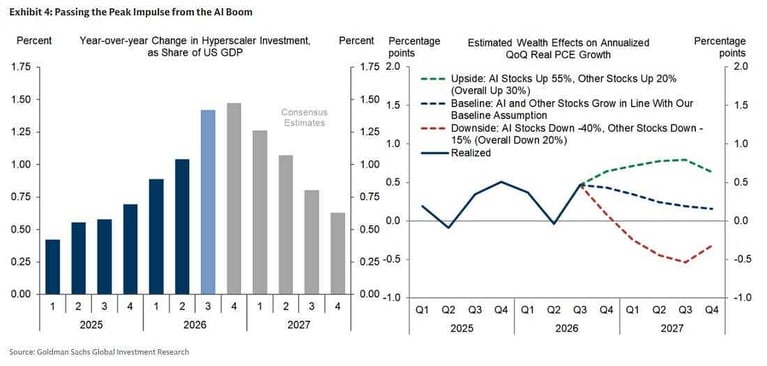
Goldman Sachs seems to think the AI boom is about to hit that moment. The left side of this week’s chart tracks the year-over-year increase in hyperscaler investment as a share of US GDP. It peaks near 1.5% this quarter, then slides to roughly 0.6% by late 2027 on consensus estimates. The spending keeps growing. It just grows by less each quarter, and GDP growth runs on the change, so the push fades.
The graph on the right side is the part I find more interesting, because it’s about consumer spending.
When stocks go up, the people who own them spend more. Economists call it the wealth effect. Goldman estimates it added 0.4 percentage points to US consumer spending growth over the past year.
Look at the solid line first. It’s jumpy. It slipped below zero in Q2 2025 (hello, tariff selloff) and dipped to about zero again in Q2 2026. When the market wobbles, the boost disappears within a quarter.
Now the dotted lines:
Baseline: stocks do roughly what Goldman expects, and the boost still fades, from about 0.5 points today to around 0.15 by the end of 2027.
Upside: AI stocks up 55%, everything else up 20%. The boost climbs to about 0.8 points.
Downside: AI stocks down 40%, everything else down 15%. Spending growth takes a hit of roughly half a point by Q3 2027.
That’s a gap of more than a full point between the best and worst case. Consumer spending is about two-thirds of GDP, so that’s a big spread between scenarios.
And the channel is narrow. The top 10% of earners did 49.2% of all US consumer spending in Q2 2025, according to Moody’s. They also own most of the stocks. So a big chunk of the economy is leaning on a small group and their portfolios which, like it or not, lean hard on AI.
The baseline is the friendly case, and even there the tailwind shrinks by about two-thirds. The downside doesn’t require anything exotic, either. The Nasdaq lost a third of its value in 2022.
Meanwhile, Apollo’s Torsten Slok says AI has delivered “zero financial payoff to corporate America outside of tech.” The productivity gains that are supposed to pick up where the capex push leaves off haven’t shown up in the numbers yet.
My guess is that we land somewhere between baseline and downside: a slower consumer in 2027, with GDP growth more exposed to AI stock prices than most forecasts admit. To be fair, Goldman’s base case is that AI pays off eventually. I hope they’re right.
For anyone near or in retirement, this one’s personal. If your spending plan assumes the market keeps doing what it’s done for the past 3 years, you’re making the same bet the economy is.
Coasting is fine, as long as nobody hits a pothole.
Sources: Goldman Sachs Global Investment Research, Exhibit 4, “Passing the Peak Impulse from the AI Boom” (via Fortune); Fortune, “AI’s boost to the U.S. economy is nearing its peak, Goldman says, as Apollo finds ‘zero financial payoff’ outside Big Tech” (Oct. 26, 2026); BigGo Finance, “Goldman Sachs: AI Infrastructure Investment Growth to Peak in Q4” (Oct. 27, 2026); Bloomberg, “Top 10% of Earners Drive a Growing Share of US Consumer Spending” (Sept. 16, 2025).